This week let’s talk about the other side of Mount Mansfield, the Underhill side! In the 1930s there were a lot of parallels and connections between Stowe and Underhill. The Civilian Conservation Corps (CCC) was active building the Underhill State Park and cutting trails. The Underhill Winter Sports Club was promoting skiing as both good recreation and also a possible economic engine. Charlie Lord laid out the Tear Drop trail that is still used today!
The first lift-served skiing was a rope tow on the Eagan Farm located below the state park. Sepp Ruschp came over from Stowe to help layout the lift. The area opened for the 1937-38 season which was one season after Stowe’s first lift. The Eagan area charged 75 cents a day or 10 cents a run for skiing.
About the same time as the Eagan Farm ski area opened, another major project started. The Underhill Winter Sports Club and Vermont State Forester Perry Merrill got $50,000 from the government to build a ski area in the old Halfway House area in the Underhill State Park. Just to put that in perspective, that’s equivalent to $1.2 million in today’s dollars so it was a significant amount.
The Halfway House was built in 1858 and was accessible by horseback or horse drawn carriages. It provided a place to stay for people who would climb Mount Mansfield. The Halfway House trail still exists today although the house itself was destroyed in 1939.
The plans for the ski area called for cutting several new trails, adding first aid caches, and two rope tows. The tows would be in sequence with the upper one topping out at 3000 feet elevation. A couple of the new trails, Halfway House and Overland, would extend all the way down to the Eagan Farm area.
When I first looked into this area for the Vermont Ski and Snowboard Museum’s Lost Ski Area project, that was about all I could find about the upper area. Did it get built? Did it ever operate? Well, enter Jamie Ide from Jericho, Vermont!
In one of those twists of fate, Ide had seen an item in the Museum’s 2023 online auction of a Mt Mansfield ski trail map from 1941. The map included certain features associated with the Underhill upper ski area, particularly the first aid caches. So he decided to explore and see what remnants he might be able to find.
Just an aside, I’ve never felt I deserve the term “ski historian!” I depend on other people’s research and try to pass it along. A true historian actively pursues the history to find artifacts or proof. In other words, they are the “Indiana Jones” of historical research. Jamie Ide is one of those.
He spent long hours exploring the western flank of Mount Mansfield and he found lots of artifacts! Many of the First Aid caches were still recognizable in various stages of decay. He found evidence of a 24’ x 36’ warming shelter, rest rooms, and lift shacks. He also found an old stove in good enough shape that if you cleaned it up, it would probably still work! He also found two field telephones and retrieved one of them. Each phone weighs 80 pounds so “retrieving” it was not easy and he tells a great story of this adventure! This phone is now on display in the Museum.
So we now have evidence that much of the infrastructure did get built. It’s still unclear how much usage the area got. The theory is that the area may have opened just in time for WWII rationing to begin and fuel was one of the rationed items. The Eagan Farm ski area was forced to shut down in 1942 because of this and so it would have affected the upper area as well.
The Eagan Farm was purchased by the Durbrow family in 1946 and the ski area was reopened with the name changed to the Underhill Ski Bowl! It would operate until 1982 when lack of snowmaking and increased insurance costs forced its closure.
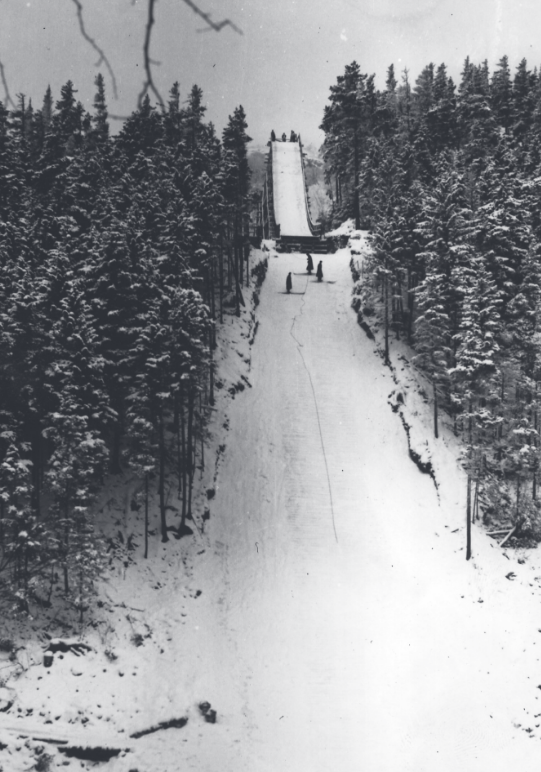
Jamie Ide also found the remains of a ski jump built in the Underhill State Park. UVM played a part in this project to provide a competitive ski jump for intercollegiate ski meets. The jump was the second largest in Vermont with the largest being the still existing Harris Hill in Brattleboro. The Underhill jump did host at least one intercollegiate meet in 1941 where Dartmouth edged the University of New Hampshire for the championship.
Leave a Reply